How can salespeople stand out against ChatGPT?
The Impact of AI on Sales Prospecting
Artificial intelligence (AI) is increasingly embedded in our day-to-day lives, from self-driving cars and automated financial investments to healthcare management and marketing chatbots.
AI is also being deployed to enhance sales performance. According to Gartner, 88% of chief sales officers (CSOs) have already invested in or are considering investing in AI. They are using it to try and boost lead volume, improve closure rates, enhance analytics, and improve forecasting accuracy.
Elevate Your Sales Prospecting Strategy
Learn how Imparta’s 3D Advantage® framework can enhance your team’s prospecting success.
The latest and perhaps most startling game changer is the release of Open AI’s ChatGPT. ChatGPT can do many things including software coding and writing children’s bedtime stories. CHATGPT is also capable of quickly writing personalised prospecting communications with minimal human input. The lack of cost and ease in which ChatGPT can generate these communications suggests that we are heading towards a prospecting landscape dominated by AI formulated content.
But how good is it? And how can real salespeople stand out in a prospecting environment cluttered with AI and bots?
Putting ChatGPT to the Test in Sales Prospecting
As experts in sales and prospecting, Imparta’s team decided to put ChatGPT to the test.
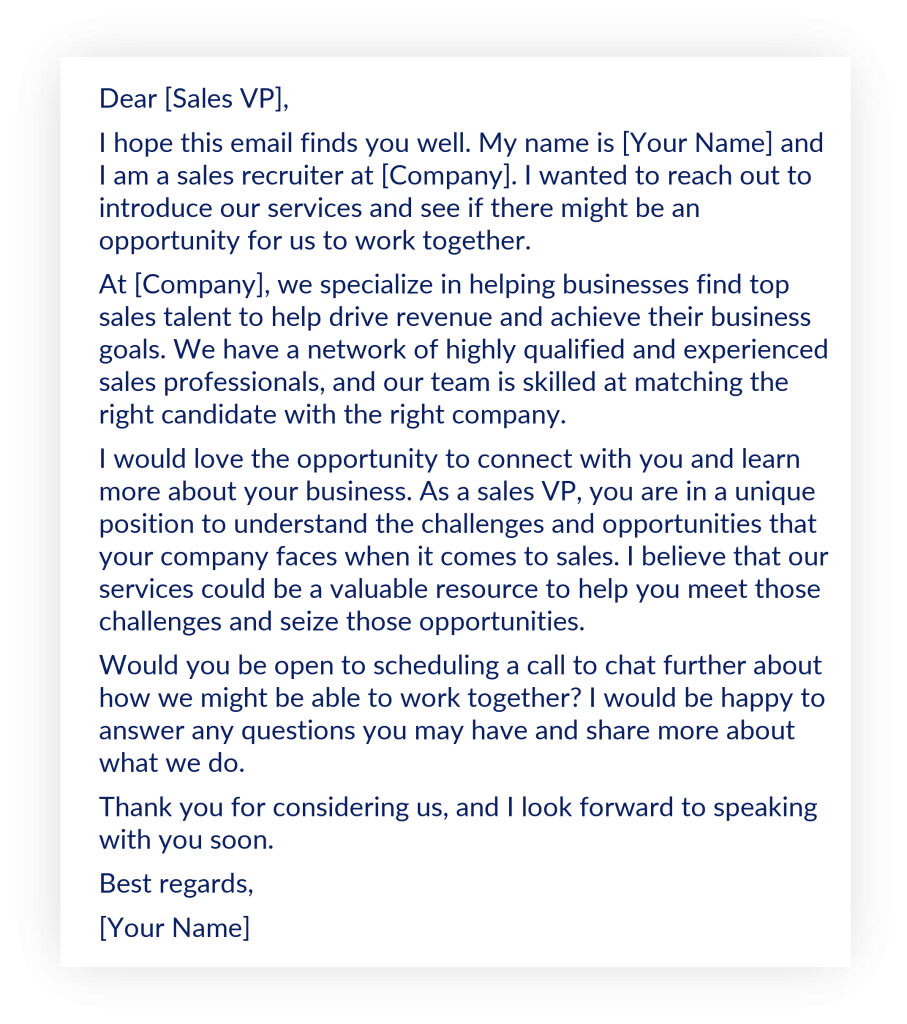
We asked ChatGPT: “Please write a prospecting email from a sales recruiter to a sales VP to introduce your services and request to connect”.
Here is the result:
Stand Out in an AI-Driven World
Learn how to leverage insight, influence and trust to outperform AI-generated messages.
Impressive, right?
Well yes, in the sense that the AI has written an email based on simple written request – something that we will take for granted soon, but just wasn’t possible until very recently. But how good is it? Would you respond if a real salesperson wrote that to you?
The problem is that ChatGPT has served up the type of drab, un-insightful communication that already gums up our email boxes. ChatGPT is in its infancy, but for now it’s hard to distinguish it from what is already written by poorly trained human salespeople. The only difference is the sheer scale at which AI can churn this out.
Given that thousands upon thousands of AI generated messages will be landing in our clients and targets’ social media channels and email inboxes, how does a salesperson prepare a standout prospecting communication?
At first glance the structure and tone of the AI message looks good, there is some level of personalisation, and the AI has laid out a value proposition and call-to-action in a coherent fashion.
However, if this had been presented as a case example in Imparta’s Prospecting Programme it would be deficient in each of the three dimensions of Imparta’s 3D Advantage® framework. The message does not bring insight to the reader, it does not influence the reader to take action, and it does not build trust. The result is likely to be a quick press on the delete button.
Why Insight, Influence, and Trust Matter in Prospecting
INSIGHT
- Talk about possible specific objectives/needs based on your research into the individual, the company and the market.
- Don’t assert that these are relevant for your connection but ask or suggest.
- It’s far better to approach a few people in a truly customised way, than many people with a generic approach.
- Outline capabilities that could help them in ways they may not have considered.
INFLUENCE
- Social proof: Show that others trust you. When people aren’t sure what to do, they look at what their peers are doing.
- Reciprocity: Give something before you ask for something in return. People have an innate desire to repay favours, even if not asked for.
- Loss aversion: Frame the desired action as a way to avoid a loss. People tend to act to avoid a loss more than they do to achieve a gain.
TRUST
- Credibility: Do your homework on the prospect so that the approach is tailored, gaining you credibility.
- Business intimacy: Relate to the prospect as an individual.
- Lack of self-orientation: Suspend your agenda. Focus on theirs.
The 3D Advantage® Audit: Assessing ChatGPT’s Weaknesses
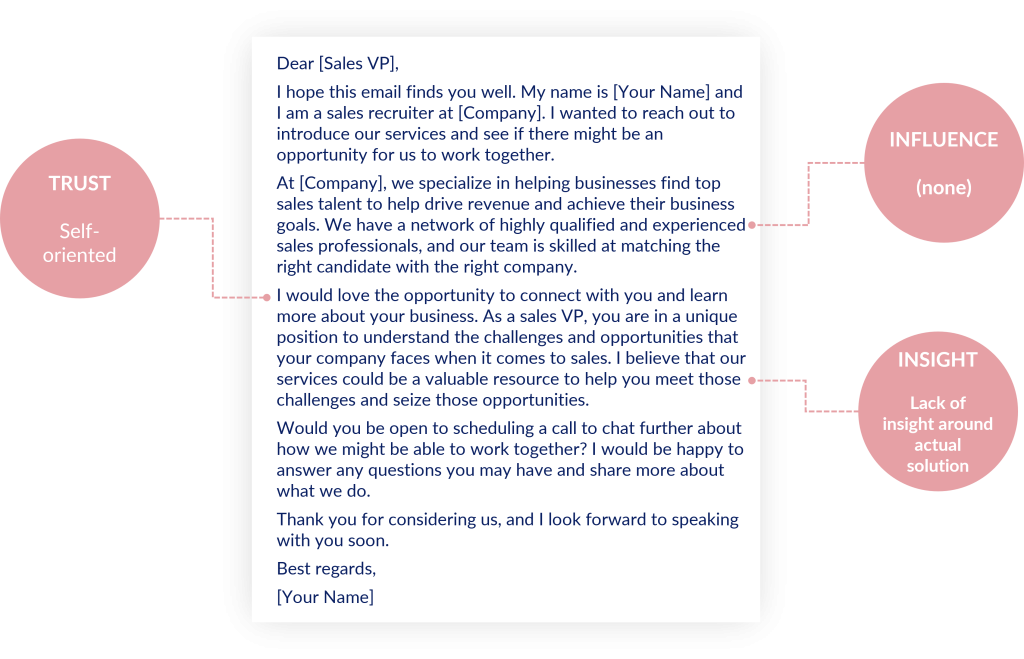
The Verdict: AI Lacks the 3D Advantage® (Insight, Influence, Trust)
As you can see, the AI email is lacking all three dimensions of Insight, Influence and Trust, and as a result it is likely to have minimal impact when prospecting.
Ready to Enhance Sales Performance?
Experience the power of i-Coach® AI in driving actionable insights and revenue growth.
In contrast, imagine you’re a Sales Director or VP, and you receive the following email. How effective would this be in raising your interest compared to the AI-generated one above?
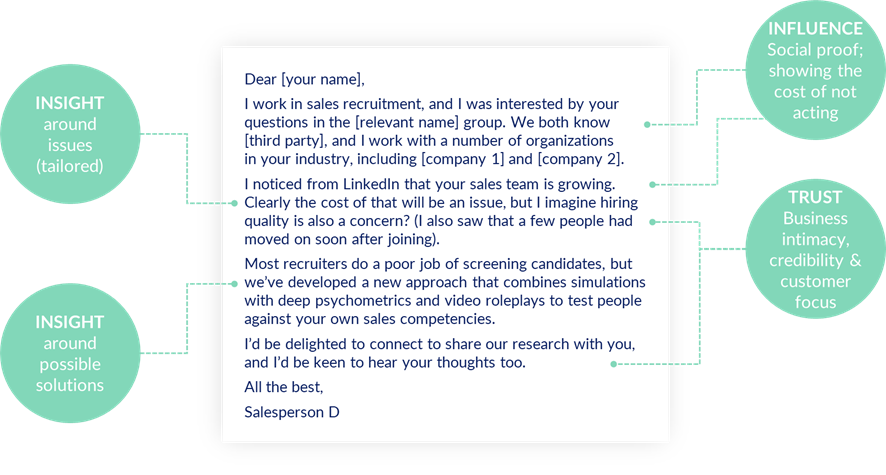
In this example, there is insight into possible issues, as well as solutions. There is strong social proof and a clear indication of the current costs of the problem (“a few people had moved on soon after joining”). Trust is established through the lack of self-orientation (“I’d be happy to share…”) and business intimacy (“I’m keen to hear your thoughts…”).
Whilst AI does show promise when it comes to crafting email outreach for sales prospecting, it is worth noting that this is just one of a choice of available channels. Every individual prospect will have different communication preferences, working habits and things that attract their attention… or antagonise them. Salespeople must diversify and adjust their approach to connecting with prospects, which is something AI is not currently able to do.
Turning AI Proliferation into Opportunity for Human Sellers
Using AI to create prospecting outreach is quick, easy, and scalable. However, there is a trade-off between quality and speed. Salespeople who invest time in researching and creating a 3D Advantage (Insight, Influence and Trust) prospecting communication will have more success in their prospecting than those who take the effortless way.
Instead of being a threat, the proliferation of AI content is an opportunity for salespeople to differentiate their approach and stand out.
If you want to ensure your sales team has the skills to take a strategic and impactful approach to prospecting and account entry, Imparta’s Prospecting Programme – part of our best-in-class modular sales curriculum – might be just what you’re looking for.
Frequently Asked Questions (FAQs)
How is AI, including ChatGPT, changing the sales prospecting landscape?
AI and ChatGPT are reshaping sales prospecting by generating large volumes of low-cost, personalised outreach at speed. With 88% of CSOs investing in AI, inboxes are filling with AI‑formulated content, creating a prospecting environment where standing out requires more than generic, automated messaging.
Why are many ChatGPT-generated prospecting emails ineffective?
Many ChatGPT-generated emails are ineffective because they tend to be generic, drab, and low in insight. They often lack the three dimensions of Imparta’s 3D Advantage® framework Insight, Influence, and Trust so they neither challenge the reader’s thinking nor motivate action, leading to quick deletion.
How can salespeople stand out against ChatGPT when prospecting?
Salespeople can stand out against ChatGPT by investing time in research and crafting prospecting messages that deliver Insight, Influence, and Trust. Rather than sending generic AI-style emails, they should tailor communication to the individual, surface specific issues, offer distinctive value, and build credibility and genuine personal connection.
What role does Insight play in helping salespeople stand out against ChatGPT?
Insight helps salespeople stand out against ChatGPT by focusing outreach on specific, researched objectives and needs at the individual, company, and market level. Instead of asserting, they ask or suggest, highlight overlooked capabilities, and show they understand the buyer’s world something generic AI output rarely achieves.
How can Influence help salespeople stand out against ChatGPT-generated messages?
Influence helps salespeople stand out against ChatGPT by applying behavioural economics, not just listing benefits. They use social proof, reciprocity, and loss aversion showing who already trusts them, giving value before asking, and framing action as avoiding a loss so prospects feel a stronger, more human reason to respond.
Why is building Trust essential for salespeople to stand out against ChatGPT?
Building Trust is essential for salespeople to stand out against ChatGPT because trust-based messages feel human, considered, and relevant. By doing real homework, showing business intimacy, and displaying low self-orientation, sellers demonstrate they care about the prospect’s agenda, not just their own, differentiating themselves from AI noise.
What weaknesses in ChatGPT emails can skilled salespeople exploit?
Skilled salespeople can exploit ChatGPT’s weaknesses: generic phrasing, lack of tailored insight, and absence of meaningful Influence and Trust cues. By contrasting this with highly customised, 3D Advantage‑based outreach, they show deeper understanding and authenticity, which prospects are more likely to notice and reward with engagement.
Beyond email, how else can salespeople stand out against ChatGPT-driven outreach?
To stand out against ChatGPT-driven outreach, salespeople should diversify channels and adapt to each prospect’s preferences, habits, and triggers. While AI largely focuses on scalable written messages, humans can mix social, phone, and other touchpoints, tailoring style and timing in ways current AI cannot easily replicate.
Future-Proof Your Sales Team
Partner with Imparta to drive continuous performance improvement across your organisation.