
When to Meet in Person vs. Virtually
A 5‑Factor Decision Framework
Author: Richard Barkey | Founder and Chief Executive Officer
Why Meeting In Person vs Virtually Matters for Sales Success
The concept of virtual selling has now become yet another skill set that salespeople must equip themselves with to succeed in the post-pandemic business landscape. Yet, it is still not clear when sales meetings should be conducted face to face, or continue in a virtual format.
When to Meet In Person: Five Key Factors to Consider
At Imparta, we have identified five situations in which it makes sense to try and meet customers in person, rather than virtually.
- Occasion. Aim to meet in person when the occasion is a moment of truth for the account when the impact is more important than how quickly it can happen. These moments of truth happen at each stage of the customer’s Buying Cycle, from early chemistry meetings to pitches, quiet conversations to frame the negotiation, onboarding and key business reviews.
- Customers. Meet your customers in person is when you have a smaller number of customers, so effectiveness is more important than efficiency.
- Relationship. Meet in person when you need to build (or re-build) trust and rapport with your customer stakeholders.
- Interaction. When the discussion needs to be intense, creative and/or deeply collaborative, that can be easier to do in person, despite the power of technology. The same is true, of course, if your job actually requires you to interact with the customer’s equipment, on-site.
- Information. If the information you need to cover is complex, subtle or nuanced, a more free-flowing in-person meeting, which includes opportunities for informal discussions as well, will tend to work better.
Finally – it’s OK to meet in person simply because you need social contact. It’s an important part of your mental health, and that’s something you need for yourself, but also to do your job well.
Download our interactive checklist to help you decide whether to meet in person or virtually.
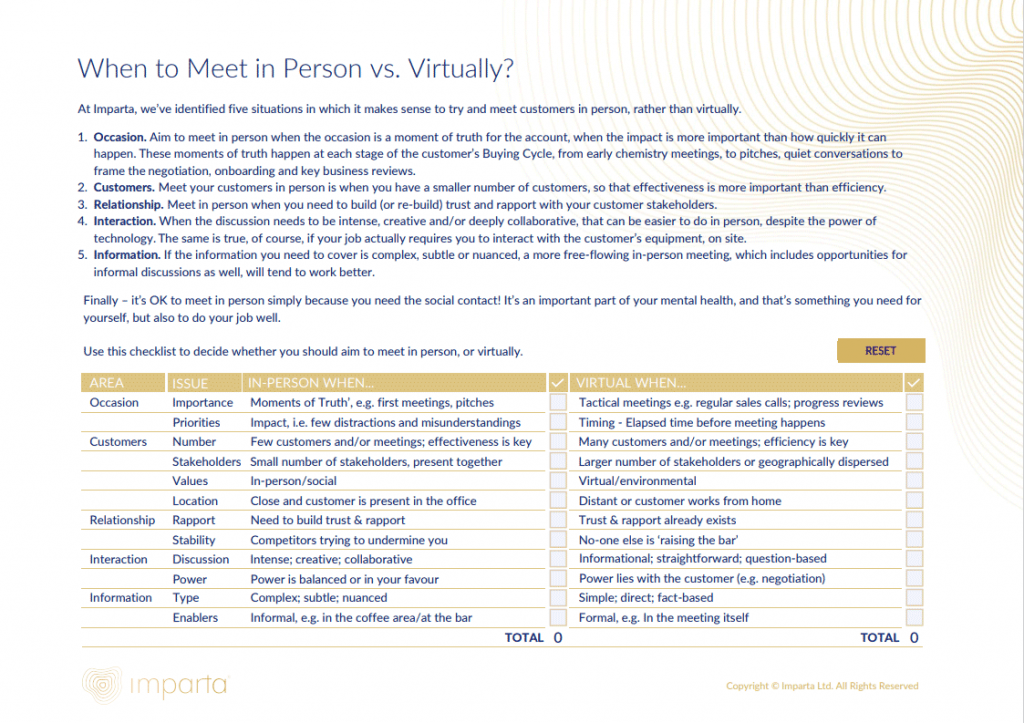
To download the checklist please enter your details below…
Frequently Asked Questions (FAQs)
What does “when to meet in person vs virtually” mean in a sales context?
In a sales context, “when to meet in person vs virtually” refers to deciding whether a meeting should be face to face or online. The decision depends on factors such as the occasion, number of customers, relationship needs, type of interaction, and complexity of information.
How should occasion influence when to meet in person vs virtually?
Occasion is central to deciding when to meet in person vs virtually. For key “moments of truth” in the Buying Cycle such as chemistry meetings, pitches, framing negotiation, onboarding, or major reviews impact matters more than speed, so a face-to-face meeting is usually the better choice.
When is it better to meet customers in person rather than virtually?
It is better to meet customers in person rather than virtually when the account has high‑stakes moments, you manage a smaller number of customers, you need to build or rebuild trust, the interaction must be intense or collaborative, or when the information is complex, subtle, or nuanced.
How does customer portfolio size affect when to meet in person vs virtually?
Customer portfolio size helps determine when to meet in person vs virtually. If you have a smaller number of customers, effectiveness becomes more important than efficiency, making in‑person meetings more appropriate. When accounts are fewer but strategically significant, the extra effort of face-to-face time is justified.
How does relationship-building guide when to meet in person vs virtually?
Relationship-building is a key factor in deciding when to meet in person vs virtually. When you need to build or rebuild trust and rapport with stakeholders, face-to-face meetings generally work better, because they support richer interaction, non-verbal cues, and informal conversations that deepen connection.
Why does interaction type matter for when to meet in person vs virtually?
Interaction type matters for when to meet in person vs virtually because certain discussions are easier in person. Intense, creative, or deeply collaborative sessions, or situations where you need to work with the customer’s equipment on-site, benefit from face‑to‑face contact despite advances in virtual technology.
How should information complexity influence when to meet in person vs virtually?
Information complexity strongly influences when to meet in person vs virtually. If the content is complex, subtle, or nuanced, an in‑person meeting with free‑flowing discussion and informal side conversations will usually work better than a virtual session, helping ensure true understanding on both sides.
Can personal wellbeing affect the choice of when to meet in person vs virtually?
Personal wellbeing can definitely affect the choice of when to meet in person vs virtually. It is acceptable to meet face to face simply because you need social contact; maintaining mental health is important both for yourself and for performing effectively in your sales role.